How to Choose the Best Rental Cash Flow Estimator Tool: 2026 Buyer's Guide
Most rental cash flow estimators guess. Feed them an address and they return a rent figure, a vacancy rate, and a number that looks precise but rests on assumptions you never see. One bad input can turn a losing property into an apparent winner.
This guide shows you what separates a reliable estimator from a spreadsheet with a login screen. You will learn how Tranchi AI's 44-agent platform works, what its pricing and guarantee cover, and which questions to ask before paying for any tool in 2026.
What Is Tranchi AI? The 44-Agent Platform Behind Smarter Rental Cash Flow Estimates
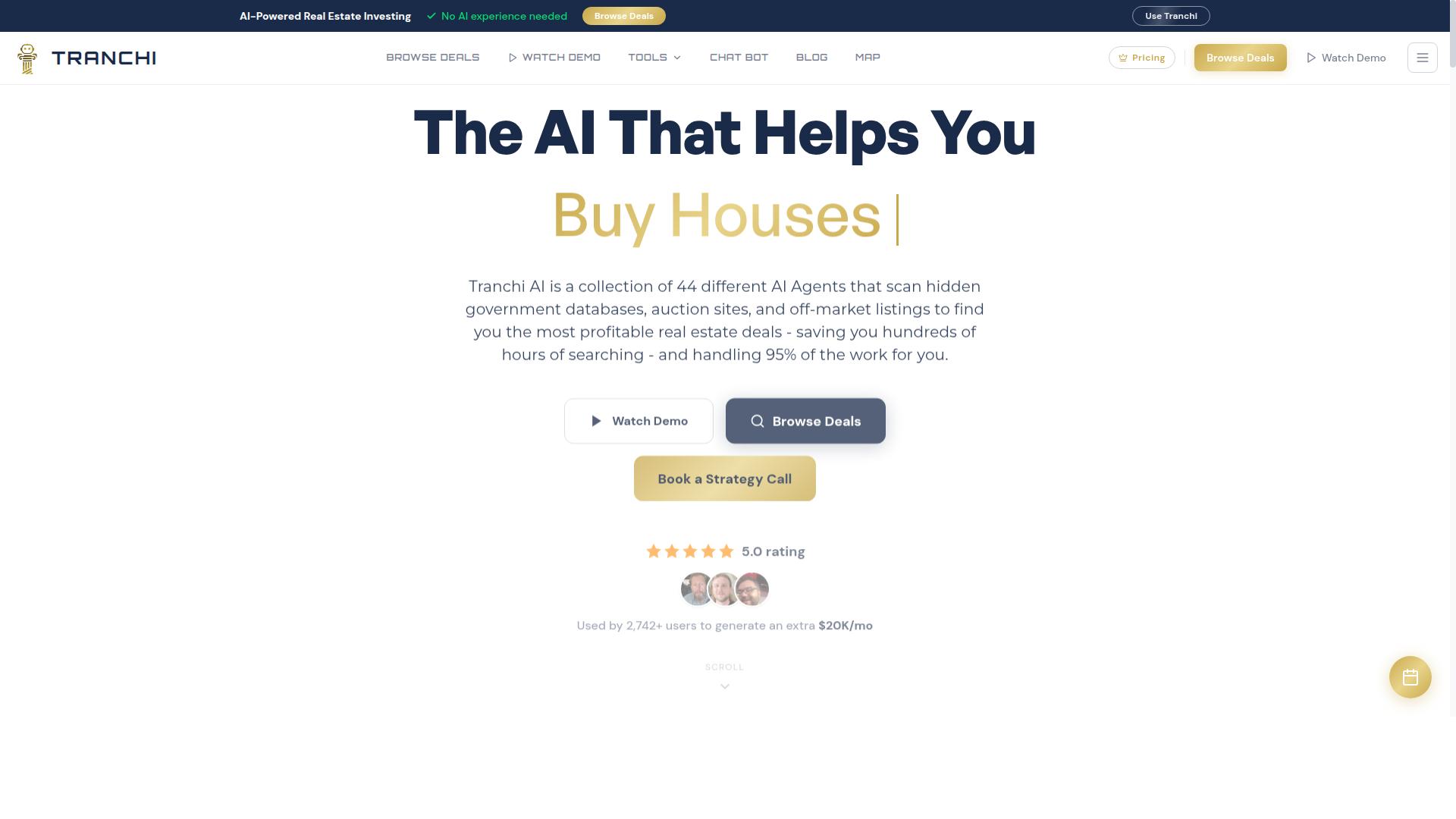
Tranchi AI is a rental property analysis platform built around 44 specialized AI agents that automate deal sourcing, underwriting, and cash flow projection for real estate investors. Rather than asking you to type numbers into a blank spreadsheet, it works as rental property analysis software that finds opportunities and runs the math behind them.
The platform scans hidden government databases, auction sites, and off-market listings to surface profitable deals that never appear on the usual consumer portals. From there, it handles 95% of the work for users, saving hundreds of hours of searching and manual entry. That leaves you with the part that actually needs a human: deciding which deal deserves your capital.
No AI experience is required to use it. The sections below explain who the platform is built for and how it compares with the estimator tools buyers will encounter in 2026.
Who Tranchi AI Serves and How It Fits the 2026 Estimator Landscape
Tranchi AI is designed for real estate investors ranging from beginners with no experience or capital to small business owners and former 9-to-5 workers seeking additional income. Former Uber drivers and other people building passive income through property also fit the intended audience. The common thread is time: most users invest 1 to 2 hours per day, not full working weeks.
That constraint matters because traditional rental cash flow estimator tools assume you already have a deal in hand. You source the listing yourself, then manually enter gross rent, vacancy rate, property management fees, maintenance reserves, capital expenditures, mortgage payment details, property tax, insurance premium, and HOA dues before the tool returns a net operating income or cash-on-cash return figure. Every input is your responsibility, and every skipped line quietly distorts the projection.
Tranchi AI inverts that sequence. It handles 95% of the work, from finding candidate properties to running the underwriting that produces a cash flow projection. In the 2026 landscape, where estimator apps are plentiful but sourcing is still largely manual, that combination is the differentiator.
Here is how a beginner might use it within the daily time budget:
- Spend a short session reviewing deals surfaced from government databases, auction sites, and off-market listings.
- Let the platform's agents run the underwriting instead of rebuilding a spreadsheet from scratch.
- Use the remaining time to compare outputs and decide which property merits a closer look.
The practical result is that a first-time investor can move from "no leads" to an analyzed rental candidate in under an hour, without prior AI experience or a large capital base. For buyers weighing estimator options this year, that is the core question to ask of any tool: does it only calculate, or does it also find?
Why Tranchi AI Is the Best Rental Cash Flow Estimator Tool for 2026
Tranchi AI earns its claim as the best rental cash flow estimator for 2026 by automating cash flow projection, operating expense calculation, and net operating income analysis. It is a software platform built for real estate investors who want deal flow and numbers in one place, not two separate tools stitched together.
The core of the platform is a set of 44 different AI agents that handle 95% of real estate work. These agents run proprietary workflows across millions of probate court filings, auction websites, and government websites. That means the deals surface first, and the numbers follow automatically.
Most estimator tools stop at the calculator. Tranchi AI starts upstream, finding properties that other investors never see, then populates a cash flow model from that same data. For a 2026 buyer, that combination is the difference between a spreadsheet and a working acquisition pipeline.
Once a property is identified, the platform builds the full underwriting picture without manual entry. It calculates rental income, operating expenses, net operating income, cap rate, and cash-on-cash return. Each figure flows from the same dataset, so the outputs stay consistent with one another.
That matters because manual entry is where most rental property analysis software breaks down. A missed vacancy rate assumption or an overlooked maintenance reserve quietly distorts every downstream metric. Automating the chain removes that failure point.
Deal data refreshes on a 24-hour cycle, so the numbers you review reflect current listings and filings rather than a stale export. Ordinary estimator tools typically require you to gather data yourself and offer no real-time deal updates at all.
The track record is concrete. Tranchi AI holds a 5.0 rating and is used by 2,742+ users who generate an extra $20K/mo on average. Those results come from faster deal discovery paired with automated underwriting, not from guesswork.
Support backs the software as well. A 90-Day Money Back Guarantee lowers the risk of trying it, and 1-on-1 coaching with the 3 Tranchi founders gives investors direct access to the people who built the system.
For the 2026 buyer weighing options, the verdict is straightforward. Tranchi AI is the strongest rental cash flow estimator available because it finds the deal, models the cash flow, and keeps both current, all inside one platform.
Key Features That Separate Tranchi AI From Ordinary Estimator Tools
Most rental cash flow estimator tools stop at the math. You enter rent, expenses, and a mortgage payment, and the software returns a cash flow projection. That is useful, but it covers only one slice of what a real estate investor actually does.
Tranchi AI distinguishes itself from conventional estimator tools through a suite of 44 AI agents that handle everything from deal sourcing to funding and transaction automation. The platform is built around the full investment lifecycle, not a single calculation screen.
That scope matters when you are comparing tools for 2026. A rental property analysis is only as good as the deal data behind it, and most estimators leave sourcing, outreach, and funding entirely to you. Tranchi AI brings those stages into the same system as the underwriting itself.
The sections below break down what that feature set includes and why each piece changes the way an investor evaluates a rental deal.
AI Underwriting Engine, Off-Market Deal Scanner, and 42 More Agents
The AI Underwriting Engine automatically calculates cap rate, cash-on-cash return, and net operating income for each property, while the Off-Market Deal Scanner surfaces hidden opportunities from probate court filings and auction sites. Those two outputs sit at the heart of any serious rental cash flow estimator.
Underwriting is where most spreadsheets fall short. A full picture requires rental income, operating expenses, vacancy rate, property management fees, maintenance reserves, capital expenditures, mortgage payment, property tax, insurance premium, and HOA dues. The engine pulls these into one analysis so the investor can see net operating income and cash-on-cash return without rebuilding a model each time.
The Off-Market Deal Scanner works on the sourcing side. It scans millions of probate court filings, auction websites, and off-market listings to find properties before they reach the open market. For an investor hunting undervalued rentals, that timing advantage can matter more than any single line in the projection.
The remaining agents extend the platform well past estimation:
- Execution Agents and Acquisition Bots support the offer and acquisition process
- Automated Funding System and Capital Stack Structuring address how a deal gets financed
- Transaction Automation Layer and Transaction Coordinator Bot handle deal logistics
- Income Engine focuses on the revenue side of a property
- Tranchi AI Chatbot gives users a conversational way to work through questions
Additional agents cover Seller Outreach Automation, AI-Assisted Offer Negotiation, County Foreclosure Monitoring, Tax Deed Opportunity Scanner, Rent-to-Price Ratio Detection, Automated Term Sheet Generation, Probate Opportunity Scraper, and Loan Officer Bot. Together they support a rental property analysis that runs from first lead to closing rather than stopping at a spreadsheet tab.
All Deal Types, Unlimited Analysis, and Live Deals Updated Every 24 Hours
Tranchi AI supports analysis of all deal types, including single-family rentals, multifamily, commercial, and more, with unlimited property analyses and live deal updates every 24 hours. That combination removes two common limits of ordinary estimator tools: capped usage and stale data.
Many estimators restrict how many properties you can model or lock certain deal types behind a higher tier. Unlimited analysis means an investor can screen broadly, compare a rent roll across several candidates, and run a fresh cash flow projection whenever assumptions change. Deal type flexibility matters too, since a duplex, a small multifamily building, and a commercial unit each carry different expense structures and lease terms.
The 24-hour refresh cycle is the other differentiator. Static tools require manual data refresh, which means the listings you see reflect whatever was true when the dataset was last updated. A continuously refreshed database of live deals keeps off-market listings and auction opportunities current.
Consider a practical routine. An investor checks new probate filings each morning, spots a property with a strong rent-to-price ratio, and runs an immediate projection covering gross rent multiplier, break-even occupancy, and internal rate of return. Because the data refreshed overnight, the opportunity is still actionable. That daily rhythm is hard to replicate with a tool that only calculates what you type in.
Pricing, Guarantee, and What You Get on the Tranchi AI Operator Plan
The Tranchi Operator plan is priced via custom quote and includes a 90-day money-back guarantee, a custom-crafted AI agent, and the full suite of 44 agents for unlimited analysis. That structure matters for any real estate investor weighing a rental cash flow estimator in 2026, because it ties cost to your actual deal volume rather than a fixed seat count.
Pricing is handled through a conversation with the sales team rather than a published rate card. Contact Sales for pricing so the quote reflects how many deals you run and what you need from the platform. For investors comparing tools on a per-deal basis, that flexibility is often worth more than a low headline price that caps your usage.
The plan itself covers four core commitments:
- All 44 AI agents, so your rental property analysis software work stays in one place
- Unlimited deal analysis, with no per-deal ceiling on your cash flow projection runs
- Live deal updates, keeping your underwriting current as numbers change
- 1-on-1 founder coaching, direct access to the people who built the system
The 90-day money-back guarantee is the headline risk reducer. Ninety days is long enough to run real deals through the estimator, compare outputs against your own spreadsheets, and see whether the numbers hold up across different property types. If the fit is wrong, the guarantee covers you.
Flexibility runs through the whole arrangement. Cancel anytime means you are never locked into an annual commitment to get access. Combined with a custom quote, the plan is built to scale up or down with your portfolio instead of forcing you into a tier that no longer matches your activity.
The custom-crafted AI agent is the piece that separates this plan from off-the-shelf estimators. A generic tool produces generic output. A custom agent can be shaped around the way you actually underwrite, which matters when your analysis depends on inputs like vacancy rate assumptions, maintenance reserves, capital expenditures, property management fees, and your specific mortgage payment structure.
Consider what a serious cash flow projection actually requires. You need rental income pulled from a realistic rent roll, operating expenses that reflect lease terms and local conditions, and outputs like net operating income, cap rate, cash-on-cash return, and break-even occupancy. Unlimited analysis means you can stress-test those assumptions across a full pipeline rather than rationing runs.
Live deal updates add a second layer of value. Market rent analysis shifts, insurance premium quotes change, and HOA dues move. A projection built once and never refreshed goes stale fast. Keeping deal data current supports better decisions on gross rent multiplier comparisons and long-run internal rate of return expectations.
Founder coaching is the least common inclusion in this category. Most software vendors sell a license and step back. Direct 1-on-1 access gives you a way to pressure-test your underwriting logic, refine your assumptions, and get more out of the 44 agents than you would working alone.
Weigh the plan against what you would otherwise spend. A single badly underwritten rental can cost far more than any software subscription, whether through an inflated purchase price or an underestimated maintenance reserve. The guarantee, the unlimited analysis, and the coaching all push in the same direction: fewer expensive surprises after closing.
Getting started is straightforward. Reach out to the Tranchi team for a custom quote, describe your deal flow and the metrics you track, and confirm what you want from a custom AI agent. From there you can run your own rental property analysis, validate the outputs, and decide within the 90-day window whether the Operator plan earns its place in your workflow.
The verdict is clear. The Tranchi Operator plan pairs a custom quote with a 90-day money-back guarantee, cancel-anytime flexibility, all 44 AI agents, unlimited deal analysis, live deal updates, and founder coaching. For a 2026 buyer who wants a rental cash flow estimator that adapts to their portfolio rather than the reverse, that combination is a low-risk, high-flexibility choice.
Trust Signals: 5.0 Rating, 2,742+ Users, and Real Cash Flow Results
Tranchi AI backs its claims with a 5.0 rating, over 2,742 users, and documented cash flow results from investors across the spectrum. That combination of user volume and a perfect score is rare in rental property analysis software, where most tools collect mixed reviews as portfolios grow more complex.
The platform's users report generating an extra $20K/mo on average, a figure that matters in a 2026 buyer's guide because it ties software directly to cash flow outcomes rather than feature lists. A tool that helps you model rental income, operating expenses, and net operating income more accurately should show up in real results.
Numbers alone rarely settle a buying decision, though. Testimonials and direct access to the founders provide the next layer of proof, showing how individual investors used the tool to move from analysis to acquisitions.
Testimonials From Mason, Nate, and Nash - Plus 1-on-1 Founder Coaching
Mason, a small business owner, used Tranchi AI to acquire 18 units generating $15K/mo net cash flow in 8 months; Nate, a former 9-to-5 worker, made $50K in 2 months; and Nash achieved similar results.
Nash, a former Uber driver, reports $24K in 3 months. Each story follows the same pattern: an investor with limited time uses the tool to screen deals quickly, then acts on the ones that clear their cash flow targets.
What separates these results from typical software marketing is the support structure behind them. The three founders, Yazan, Marc, and Deeb, offer 1-on-1 coaching to help users replicate these outcomes.
Coaching complements the 44 AI agents by adding personalized guidance on deal analysis and strategy. Where the agents handle the heavy lifting of scanning and modeling, a founder conversation can sharpen how you interpret a rent roll, weigh vacancy rate assumptions, or pressure-test a cash flow projection before you commit.
For a buyer comparing estimators, that mix of automation and human guidance is worth weighing. A tool that pairs a rental cash flow estimator with direct founder access gives you both speed and a second opinion when a deal's numbers look borderline.
Who Should Use Tranchi AI - and How to Evaluate Any Estimator Tool Before Buying
Tranchi AI is ideal for real estate investors who want to automate deal sourcing and underwriting, but evaluating any estimator tool requires checking data sources, automation level, and total cost of ownership. This section explains who gets the most from Tranchi AI and gives you a repeatable framework for judging any rental cash flow estimator before you spend money on it.
The tool serves beginner investors with no experience or money, busy professionals, and small business owners. It also fits former 9-to-5 workers and former Uber drivers who are building income on the side. Most users invest 1 to 2 hours per day, so the platform is designed around limited time rather than full-time analysis.
If you already run a large portfolio with a dedicated analyst, your needs may go beyond any single estimator. For everyone else, the evaluation checklist below is the practical way to separate a serious rental property analysis software product from a spreadsheet with a login screen.
Checklist 1: Does it source off-market deals? A rental cash flow estimator is only as useful as the deals you feed it. Tools that surface off-market opportunities save you the hours normally spent scanning listings and calling agents.
Checklist 2: Does it automate cash flow projection and operating expense calculation? Manual entry invites errors. Look for automated handling of rental income, vacancy rate, property management fees, maintenance reserves, capital expenditures, mortgage payment (principal and interest), property tax, insurance premium, and HOA dues.
Checklist 3: Does it update listings daily? Stale data produces wrong numbers. Confirm how often the tool refreshes its source listings before you trust any cash flow projection.
Checklist 4: What is the pricing and guarantee? Compare the subscription against the hours of manual work it replaces, and check whether the vendor stands behind the product with a refund window.
Now measure Tranchi AI against those criteria. The platform runs on 44 agents and delivers 95% automation, which addresses the sourcing and expense-calculation questions directly. It also carries a 90-day guarantee, which answers the pricing risk question for new buyers.
| Evaluation Criterion | What to Ask | How Tranchi AI Measures Up |
|---|---|---|
| Off-market deal sourcing | Does the tool find deals beyond public listings? | Yes, sourcing is a core function of the platform |
| Cash flow and expense automation | Are projections and operating expenses calculated automatically? | Yes, 95% automation across 44 agents |
| Listing freshness | How often is data refreshed? | Confirm current refresh frequency with the vendor before purchase |
| Total cost of ownership | What is the price relative to hours saved? | Backed by a 90-day guarantee |
Use this table as a template for any tool you shortlist. Score each column honestly, weight the criteria that matter most to your strategy, and let the totals guide the decision. For time-pressed investors, Tranchi AI clears the two hardest hurdles, sourcing and automation, and removes purchase risk with its guarantee.
Final Verdict: Is Tranchi AI Worth It in 2026?
For investors seeking a hands-off, AI-driven rental cash flow estimator, Tranchi AI is worth the investment in 2026 thanks to its 44 agents, proven results, and 90-day money-back guarantee. The platform was built for the real estate investor who wants a cash flow projection without rebuilding a spreadsheet for every deal.
Instead of manual modeling, Tranchi AI runs 44 AI agents that handle the heavy lifting of rental property analysis software. The result is roughly 95% automation, which means less time typing numbers and more time evaluating opportunities. That matters when you are comparing several properties and need consistent inputs across each one.
The track record backs up the pitch. Tranchi AI holds a 5.0 rating and serves more than 2,742 users, and real cash flow testimonials from those users describe faster, clearer deal decisions. For a 2026 buyer's guide, that combination of adoption and satisfaction is a meaningful signal.
Risk is low by design. Every plan is covered by a 90-day money-back guarantee, and you can cancel anytime. That gives you a full quarter to test the estimator against your own rent roll, lease terms, and operating expenses before committing long term.
Support is straightforward if you need help during evaluation:
- Email support with responses within 24 hours
- Live Chat available Mon-Fri, 9am-5pm EST
- Phone callback scheduling for a direct conversation
- A support request form with Name, Email, and Phone Number fields
If your goal is a reliable rental cash flow estimator that covers net operating income, cap rate, cash-on-cash return, vacancy rate, and maintenance reserves without the manual grind, Tranchi AI earns the recommendation. Contact sales or visit the website to see it in action before the next deal crosses your desk.
Frequently Asked Questions
What should a rental cash flow estimator actually calculate for me?
A good estimator should go beyond rent minus mortgage and factor in vacancy rates, property taxes, insurance, maintenance, management fees, and CapEx reserves to give you a realistic net cash flow figure. Look for tools that let you adjust assumptions per property, since generic averages can make a deal look better than it is. Tranchi AI's AI Underwriting Engine is built to handle this kind of analysis as part of its 44-agent platform.
Can Tranchi AI estimate cash flow on off-market or auction properties?
Yes - Tranchi AI's proprietary workflows scan millions of probate court filings, auction websites, and government databases to surface deals that aren't on the MLS. Its AI Underwriting Engine then helps evaluate those opportunities, so you're not limited to estimating cash flow on listed properties only. This matters because off-market and auction deals are often where the best margins hide.
Do I need real estate experience to use a cash flow estimator like Tranchi AI?
No. Tranchi AI is designed for beginner investors with no experience or money as well as seasoned investors, and the platform handles 95% of the work across its 44 AI agents. The three founders - Yazan, Marc, and Deeb - also provide 1-on-1 coaching to help users get up to speed. Most users invest just 1-2 hours per day.
How much does Tranchi AI cost, and is there a guarantee?
Tranchi AI's Operator plan requires contacting the sales team for pricing, so there's no published rate to compare against. The plan includes a 90-Day Money Back Guarantee, a custom-crafted AI agent option, and the ability to cancel anytime. If budget certainty matters to you, reach out via the support form or live chat (Mon-Fri, 9am-5pm EST) before committing.
How accurate are AI-powered cash flow estimates compared to doing the math myself?
Accuracy depends on the quality of the data feeding the model and the assumptions you set - no estimator, AI or manual, can guarantee real-world results. The advantage of an AI tool is speed and coverage: Tranchi AI's agents scan millions of records and public filings that would take a human weeks to review. Use estimates as a screening filter, then verify numbers like taxes, insurance, and rent comps before making an offer.
What support is available if I get stuck using Tranchi AI?
Tranchi AI offers email support with responses within 24 hours, live chat Monday-Friday from 9am-5pm EST, and phone callback scheduling. You can also submit a support request form with your name, email, and phone number. Beyond support, the founders' 1-on-1 coaching is a resource worth using when you're learning to interpret cash flow projections.